 EN

Why oven temperature becomes a cost lever, not just a process setting
Industrial coating lines rarely fail because of one dramatic mistake. More often, money leaks through repeated small decisions: oven setpoints, line loading, cure windows, and rework. Low-temperature curing thermosetting powder coating has become a popular topic because it touches all four. Instead of treating the bake stage as a fixed cost, plants can treat it as an adjustable part of production. That shift matters when energy budgets are tight and delivery schedules are unforgiving.
Powder coating already avoids solvents, which helps with environmental compliance and shop floor safety. But the curing step still consumes significant energy. A conventional thermoset powder may require a higher oven temperature and a longer residence time to reach full film properties. A low-temperature curing system is designed to flow, crosslink, and adhere at a lower thermal load. The result is not just a smaller gas bill. It can also mean less heat stress on substrates, faster cooling, and more flexibility in how parts are hung and sequenced.
What makes thermosetting powder coating different from a simple paint film
Thermosetting powder coating is not a thermoplastic that softens and reflows after application. It is a reactive system. During baking, resin and crosslinker react to form a network. That network gives the finish its chemical resistance, mechanical strength, and durability. Because the reaction is irreversible, the coating cannot be remelted and reshaped like a thermoplastic powder.
This chemistry explains why cure schedule matters so much. If the film receives too little heat, the network stays underdeveloped. Adhesion, impact resistance, and solvent resistance may fall short. If the film receives too much heat, the coating can yellow, chalk, or become brittle. Energy is wasted, and the substrate may warp. A low-temperature curing thermosetting powder coating aims to hit the sweet spot with less oven energy, but it still depends on a balanced formulation and a controlled process.
| Process factor | Conventional thermoset powder cure | Low-temperature curing thermoset powder |
|---|---|---|
| Oven thermal load | Higher | Lower |
| Cure window | Broader in some systems | Tighter, more process-sensitive |
| Substrate heat exposure | Greater | Reduced |
| Energy demand | Higher | Lower |
| Process control need | Standard | Higher, especially airflow and line speed |
| Suitability | Wide range of metal parts | Best for heat-sensitive or thick-thin mixed loads |
Low-temperature curing chemistry without overselling the magic
Lower bake temperatures do not come from a single additive. They come from resin selection, crosslinker reactivity, catalyst balance, filler loading, and pigment choice. A formulator has to protect storage stability, powder flow, and final film performance at the same time. A resin that reacts too quickly may gel in the extruder or lose smoothness. A catalyst that works too well may shorten shelf life or create uneven cure in thick sections.
That is why low-temperature curing is not automatically a drop-in replacement. It works best when the coating supplier understands the substrate, the oven, the line speed, and the part geometry. For example, a thick steel bracket and a thin steel panel do not heat at the same rate. A low-temperature system can reduce the gap, but it cannot erase physics. Airflow, hanging density, and oven recovery time still shape the result.
Industry standards such as ISO 9001 and ISO 14001 provide useful discipline. ISO 9001 pushes consistent process control and traceability. ISO 14001 encourages measurable energy review. Neither standard cures a coating, but both help a plant prove changes are controlled rather than accidental.
Energy savings that show up beyond the gas meter
The obvious saving is oven fuel. A lower setpoint and shorter cycle reduce demand on burners, electric elements, or heat exchangers. Yet the bigger operational gains often appear elsewhere. Cooling tunnels work less. Parts can be unloaded sooner. Conveyor speed can sometimes be adjusted to match upstream and downstream bottlenecks. Less heat also means less stress on seals, bearings, and sensors around the oven.
A 2023 process heating review from the U.S. Department of Energy notes that process heating can account for a substantial share of industrial energy use. That makes curing a natural target for efficiency work. Savings still depend on the baseline. A plant with a tight oven, good insulation, and low excess air may see modest gains. A plant with oversized burners, leaky doors, and inconsistent loading may see much more. Low-temperature curing is a tool, not a guarantee.
There is also a quality angle. When a substrate stays cooler, thin-gauge metal is less likely to warp or oil-can. Heat-sensitive assemblies with seals, inserts, or mixed metals can be less risky to coat. That can reduce rejects and rework, which often costs more than the gas itself.
Where low-temperature curing works well, and where it does not
Low-temperature curing thermosetting powder coating tends to shine in metal fabrication where parts are heat-sensitive, where oven capacity is a bottleneck, or where energy contracts make every degree expensive. It can be a strong fit for epoxy, epoxy-polyester, and special functional powder systems when the formulation is matched to the application. It is not a universal answer. Heavy steel castings with large thermal mass may still need a robust cure schedule. Lines with poor oven uniformity may struggle to get consistent results from a tighter cure window.
A real-world example: during a retrofit at a metal storage cabinet plant in southern China, the existing line ran a standard thermoset powder. Thick door frames and thin side panels came out with different cure levels. Warping and color variation caused rework. The plant switched to a low-temperature curing epoxy-polyester powder, adjusted hang spacing, and improved oven airflow. Gas consumption fell, but the bigger win was fewer rejects. The trade-off was clear: the line needed tighter daily checks on oven temperature and line speed. The change worked because the process was managed, not just because the powder was labeled low-temperature.
Hsinda's role in practical powder coating supply
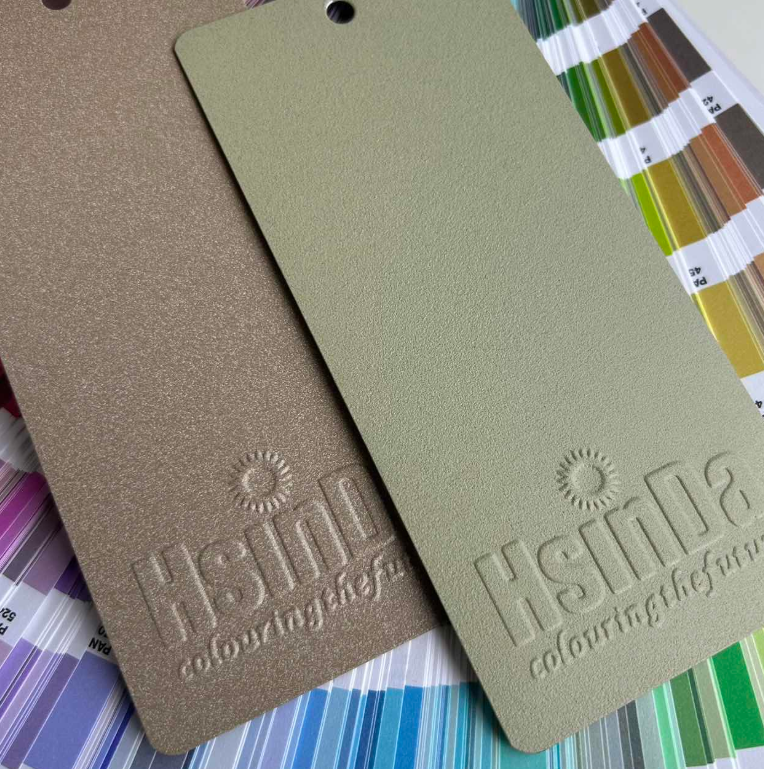
For buyers evaluating low-temperature curing options, supply reliability and process support matter as much as formulation. Hsinda runs an ERP management system aligned with European standards and a digital MES production system. Annual capacity is around 5,000 tons, supported by 8 large production lines and 3 small experimental lines. The range covers epoxy powder coatings, epoxy-polyester powder coatings, and special functional powder coatings. Certifications include ISO14001, CE, ISO9001, RoHS, Florida test, and antibacterial test. An R&D center helps match powder systems to real line conditions. For plants trying to cut curing energy without losing film performance, that practical support can make the difference between a trial and a stable production change.
Table of Contents
- Why oven temperature becomes a cost lever, not just a process setting
- What makes thermosetting powder coating different from a simple paint film
- Low-temperature curing chemistry without overselling the magic
- Energy savings that show up beyond the gas meter
- Where low-temperature curing works well, and where it does not
- Hsinda's role in practical powder coating supply